Welcome




TolerAnt sustainabLe EfficieNT
Overcoming the Tolerance-Efficiency Dilemma for Robust and Flexible Future (Bio)Chemical Processes
Funded by the Deutsche Forschungsgemeinschaft (DFG) | Funding period: November 2026 – October 2031
Thanks for applying!
We don’t accept additional applications
The current education of (bio)chemical engineers is shaped by traditional petrochemistry with its doctrine of peak performance optimization.
TALENT is the first coordinated research initiative in (bio)chemical engineering, which comprehensively addresses the tolerance-efficiency dilemma across scales and integrates these methodological innovations along the entire process chain.
The next generation of engineers must adopt an entirely new mindset
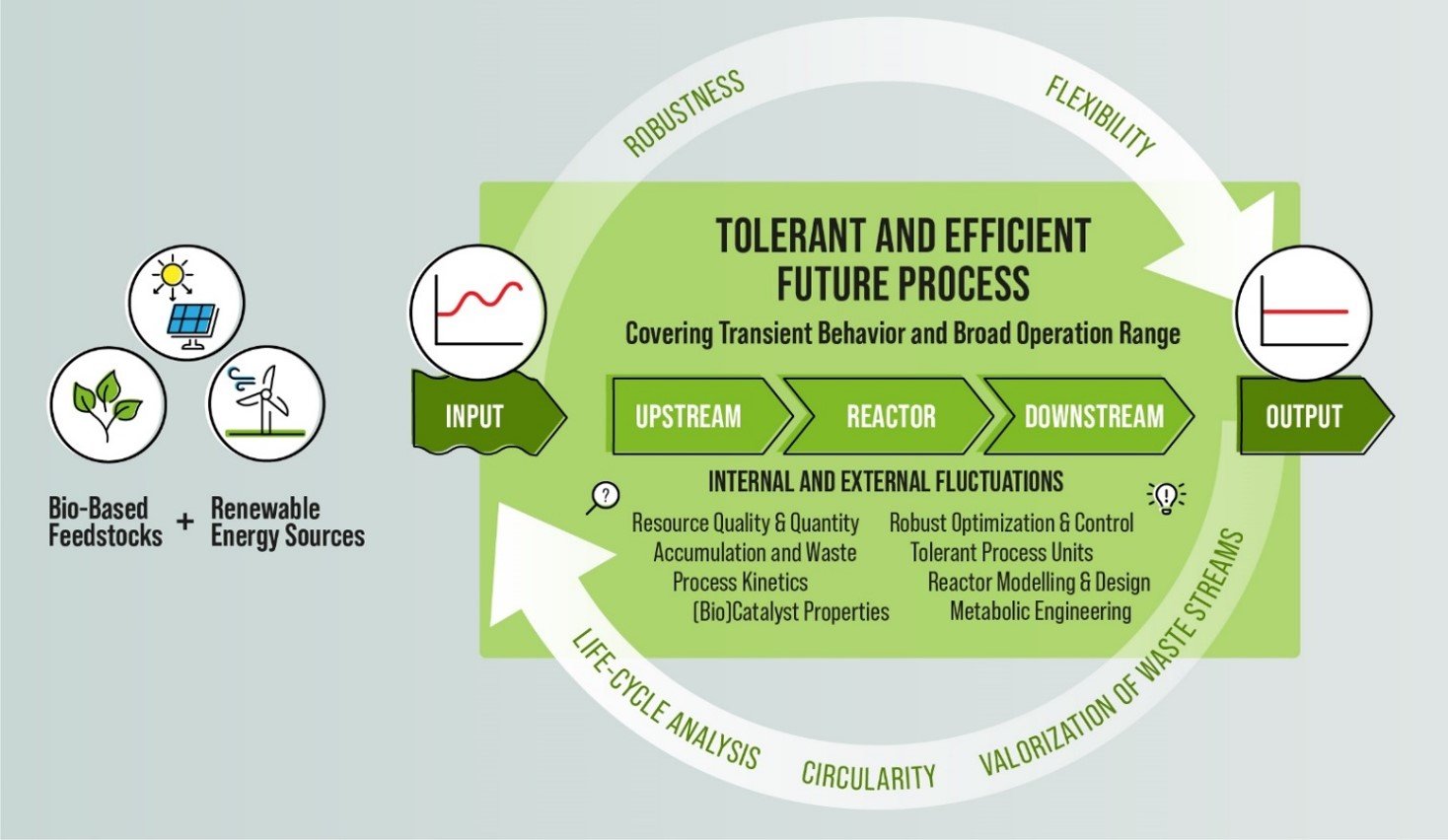
TALENT – TolerAnt sustainabLe EfficieNT – is a Research Training Group (Graduiertenkolleg) funded by the Deutsche Forschungsgemeinschaft (DFG) at TU Dortmund University. The group addresses one of the central challenges of the sustainable chemical industry: the Tolerance-Efficiency Dilemma. As the chemical sector transitions away from fossil feedstocks towards bio-based raw materials and renewable energy sources, processes must become tolerant to the inherent variability in these inputs while still maintaining high efficiency, product quality, and economic viability.
TALENT trains the next generation of (bio)chemical engineers to master this challenge, equipping doctoral researchers with cutting-edge scientific methods, interdisciplinary skills, and career-oriented training for leadership roles in academia, industry, and entrepreneurship. With nine interconnected projects spanning the molecular scale, individual process units as well as integrated process design and assessment, TALENT offers outstanding research and qualification opportunities across the full spectrum of (bio)chemical engineering.
Research Training Group Structure
Area 1 – Design of Tolerant (Bio)Chemical Conversions: Projects P1, P2, P3
Area 2 – Design of Tolerant Reactors and Separation Units: Projects P4, P5, P6, P7
Area 3 – Design of Tolerant Processes and Techno-Economic Evaluation: Projects P8, P9
Timeline of the Application Process

Project Area 1:
Design of tolerant (bio)chemical conversions
-
Strain engineering for tolerant biosynthesis of polyunsaturated fatty acids from lignocellulosic biomass
-
Bioprocess development for the tolerant production of polyunsaturated fatty acids
-
Capillary flow hydrogenation of polyunsaturated fatty acids under variable feed conditions
Project Area 2:
Design of tolerant reactors and separation units
-
Model-based design and optimal operation of a tolerant reactor for glycerol valorization based on reaction kinetic analysis
-
Adjustable structured catalysts for the tolerant operation of multiphase reactors
-
A Multiscale Numerical-Experimental Framework for the Design of an Electrified Tolerant Biomass Pyrolysis Process
-
Flexible separation of (side-)products from main process streams with variable concentration and throughput
Project Area 3:
Design of tolerant processes and techno-economic evaluation
-
Tolerant production processes with bio-based raw materials via adaptive model predictive control
-
Techno-economic and ecological assessment of processes based on systematic analysis of the toleranceefficiency balance
Read the Project Descriptions here: